
This Corporate Governance Overview Statement (“CGS”) provides a summary of the corporate governance practices of PPB Group Berhad (“PPB” or “the Company”) and its subsidiaries (“Group”) during the financial year ended 31 December 2025 (“FY2025”) with reference to the three Principles in the Malaysian Code on Corporate Governance (“MCCG”), viz:
Principle A
Board leadership and effectiveness
Principle B
Effective audit and risk management
Principle C
Integrity in corporate reporting and meaningful relationship with stakeholders
It also highlights key focus areas and future priorities relating to our corporate governance practices.
This statement should be read together with the Company’s FY2025 Corporate Governance Report (“CGR”) which is based on a prescribed format to provide a more detailed description of the Group’s corporate governance practices vis-à-vis the MCCG. The CGR is available on the websites of Bursa Malaysia (http://www.bursamalaysia.com) and PPB (https://www.ppbgroup.com). The CGS should also be read in tandem with other statements/reports in/issued together with the 2025 Annual Report, viz the Audit and Risk Committee Report, Statement on Risk Management and Internal Control, and the 2025 Sustainability Report.
The Group’s governance structure during the year was as follows :
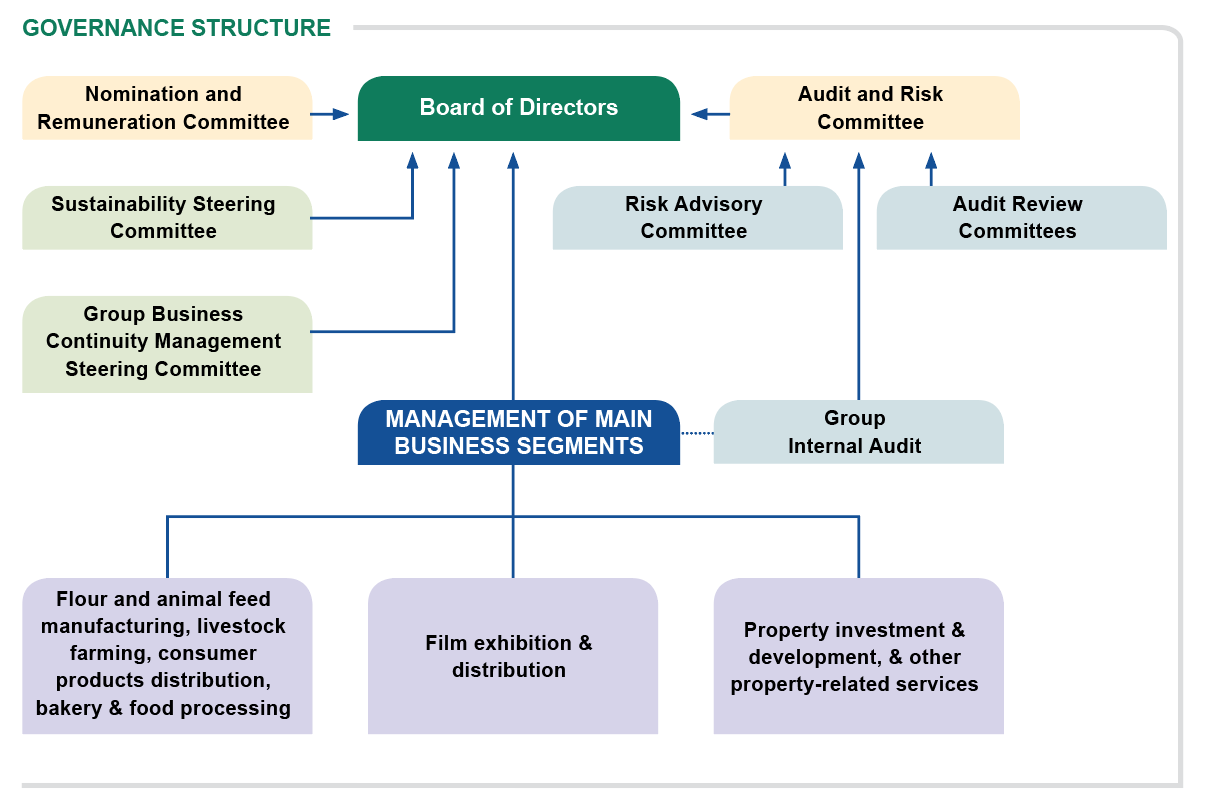
Notes:
- The previous separate Nomination and Remuneration Committees were replaced by a combined Nomination and Remuneration Committee during the year.
- During the year, the Integrity function was integrated into the Compliance scope of the Legal function. Accordingly, the previous Group Integrity Steering Committee was dissolved.
PRINCIPLE A – BOARD LEADERSHIP AND EFFECTIVENESS
Board Responsibilities
The Board charter sets out matters reserved for the Board’s decision and outlines the Board’s roles and responsibilities. The schedule of matters for the Board’s decision includes amongst others, the overall Group strategy and direction; major policies, board and board committee appointments; approval of financial statements, corporate plans and budgets, material acquisitions and disposals of assets, and major investments. The Board charter includes the Board’s responsibilities on environmental, social and governance (“ESG”) matters which are pertinent and material to the Group and its stakeholders; as well as effective stakeholder communication and engagement.
The Board has oversight of the overall performance and control of the Group, setting and reviewing the strategic direction of the Group, and monitoring the implementation by management of that strategy. Specific responsibilities are delegated to several committees. These committees operate within Board-approved terms of reference, and have authority to examine issues and report to the Board with their findings and recommendations.
The roles of the Chairman and Group Managing Director are separate. The non-executive Chairman’s responsibilities include overseeing the governance process, providing board leadership on policy formation and decision-making, and ensuring that appropriate steps are taken to provide effective communication with stakeholders. The Group Managing Director is responsible for overseeing the development and operations of the Group’s businesses, and implementing corporate strategies and objectives adopted and approved by the Board.
The Board sets the standards of conduct and personal behaviour to maintain a uniform set of values and ethics within the Group. An updated Group-wide code of ethics and conduct was approved by the Board in 2024. A set of ‘Whistleblowing Policy and Procedures’ has been adopted by the respective business units throughout the Group, and is incorporated in the employee handbook. It is also available on the Company’s website :
Anti-bribery and corruption
The Board is responsible for the oversight of the Group’s Anti-Bribery and Corruption (“ABAC”) programme. It is committed to complying with anti-bribery and corruption laws in Malaysia and other countries in which the Group operates, and has approved the ‘Group ABAC Policy and Procedures’ (“ABAC P&Ps”) which applies to all directors and employees of the Group as well as business associates.
The ABAC P&Ps sets out PPB’s stance against bribery and corruption, managing conflicts of interest, policy on gifts, hospitality and entertainment, donations and sponsorship, handling facilitation payment requests and whistleblowing. It is communicated to all parties with whom the Group has business dealings, and is accessible to the public via the Group entities’ corporate websites. It may be viewed at the Company’s website :
The Company conducts an annual mandatory ABAC training for its Directors and employees.
The Legal and Compliance Department is tasked with overseeing the design, implementation, management, and continuous improvement of the ABAC programme and providing regular reports to the Board.
Governing sustainability
The Board has oversight responsibility to deliver sustainable value to stakeholders through the principles, policies, objectives and strategies of the Group. In carrying out this responsibility, the Board is supported by the Sustainability Steering Committee (“SSC”). The SSC is chaired by the Group Managing Director of PPB and comprises the Group Head of Sustainability, PPB’s department heads, as well as the chief executives and sustainability officers of the business units. The respective business units set, monitor and review ESG and sustainability targets, and report the performance/ results achieved to the Board through the SSC.
The present Group Strategic Plan (2024-2028) includes sustainability goals, strategies and plans of the various business units. The Board has adopted a 5-year sustainability roadmap for the period from 2022 to 2026, which translates the Group’s vision and strategy into targets and initiatives to be achieved within the set timelines. The roadmap and plans are under the purview of the Board and the SSC.
In 2025, the Board reviewed a decarbonisation roadmap for Scope 1 and Scope 2 emissions, outlining the Group’s pathway to reduce operational greenhouse gas emissions through the adoption of renewable energy and energy efficiency initiatives.
The Audit & Risk Committee assists the Board in overseeing the Group’s risk governance and enterprise risk management (“ERM”) framework, including climate-related risks. This structure supports the Group’s management and oversight of climate-related matters in line with the IFRS Sustainability Disclosure Standards.
Further details of the Group’s sustainability-related activities are set out in the 2025 Sustainability Statement and Report which are available on the websites of Bursa Malaysia (http://www.bursamalaysia.com) and PPB (https://www.ppbgroup.com).
Board and Committee meetings
The meetings of the Board and Board Committees held in FY2025 and attendance record are set out below :
| Name of Director | Number of meetings | |
|---|---|---|
| Held | Attended | |
| Board of Directors | ||
| Dato’ Capt Ahmad Sufian @ Qurnain bin Abdul Rashid (Chairman) | 6 | 6 |
| Mr Lim Soon Huat | 6 | 6 |
| Mr Soh Chin Teck | 6 | 6 |
| En Ahmad Riza bin Basir | 6 | 6 |
| Tengku Nurul Azian binti Tengku Shahriman | 6 | 6 |
| Ms Yip Jian Lee | 6 | 6 |
| Ms Wee Lay Hua | 6 | 6 |
| Madam Tam Chiew Lin (Retired on 15 May 2025) | 2 | 2 |
| Audit and Risk Commitee | ||
| Ms Yip Jian Lee (Chair) | 5 | 5 |
| Mr Soh Chin Teck | 5 | 5 |
| Tengku Nurul Azian binti Tengku Shahriman | 5 | 5 |
| Ms Wee Lay Hua (Appointed on 1 July 2025) | 2 | 2 |
| Madam Tam Chiew Lin (Ceased on 15 May 2025) | 2 | 2 |
| Nomination and Remuneration Commitee | ||
| Tengku Nurul Azian binti Tengku Shahriman (Chair) | 3 | 3 |
| En Ahmad Riza bin Basir | 3 | 3 |
| Ms Wee Lay Hua (Appointed on 1 July 2025) | 1 | 1 |
| Madam Tam Chiew Lin (Ceased on 15 May 2025) | 2 | 2 |
| Mr Soh Chin Teck (Resigned on 1 July 2025) | 2 | 2 |
In exercising their duties, directors have access to information within the Company and the support of the company secretary. The company secretary also updates directors on statutory, regulatory and related governance requirements relating to the discharge of their duties and responsibilities.
Board composition
The Board comprises more than one-third independent directors; of the seven Board members at end-2025, three are independent. The remainder of the Board comprised three non-independent non-executive directors (one of whom is the Chairman), and the Group Managing Director.
Subsequent to the year-end, Dato’ Kuok Meng Xiong was appointed as an additional non-independent non-executive director.
The independent directors are able to carry out their duties and express their views unfettered by familiarity, or business or other relationships. They provide skills, competencies as well as broader views to enhance the Board’s effectiveness.
The Board strives to achieve a balance and mix of skills, experience and perspectives amongst its directors, to collectively bring a range of experience, business, financial and technical expertise for effective oversight of the Group’s businesses, and fulfil the Board’s duties and responsibilities.
Annual re-election of directors
In accordance with the Company’s Constitution, one third of the directors retire by rotation at the AGM every year, and are subject to re-election by members. No director shall serve for more than three years from his/her last election.
The Nomination and Remuneration Committee (“NRC”) also reviews annually the training undertaken by Directors and recommends topics which are relevant or of interest to the Board to keep abreast with business and regulatory developments. The Company organised several training sessions in 2025 which Directors attended, and these included the following :
Training sessions:
-
The global and Malaysian economic outlook.
- Business strategy in a world beyond 1.5º Celsius.
-
Preparing for IFRS Sustainability Disclosure Standards (IFRS S1 and S2) in Malaysia.
-
The annual cyber-security training which included awareness of the Group’s AI usage.
-
The annual compliance training which covered anti-bribery matters, including regulatory compliance and ethical conduct.
-
A briefing on the key amendments to the Personal Data Protection Act 2010, and update on the Group’s personal data protection framework.
In addition, the following Directors attended other training sessions during the year, and the topics included :
| Name of Director | Title/Subject |
|---|---|
| Tengku Nurul Azian binti Tengku Shahriman |
|
| Ms Yip Jian Lee |
|
| Ms Wee Lay Hua |
|
The criteria for evaluation of candidates for appointment as directors (and senior management positions) include their qualification, occupation, professional and business experience, and is subject to the Company/ Group’s requirements and operating environment. Prospective candidates are not discriminated based on gender, age, cultural background etc.
The Group recognises the importance of identifying and developing potential leaders and managers to fill key positions (whether on the board or senior management) in the Company and Group, from both internal and external sources. This is an ongoing process based on the Group’s immediate and longer term needs in terms of skills, expertise, knowledge and experience.
Board evaluation
Candidates for board appointments are reviewed by the NRC and evaluated in accordance with the Directors’ Fit and Proper Policy of the Company before recommendation to the Board. The NRC is chaired by Tengku Nurul Azian binti Tengku Shahriman, an independent director.
The NRC reviews annually the Board size and composition, diversity (including gender diversity), as well as the mix of Directors necessary for the successful direction of the Company and Group’s businesses. The NRC also reviewed a Board assessment, and assessment of the independent directors for 2025 which covered their experience and expertise/knowledge in the following areas :
- Business knowledge
- Accounting and financials
- Corporate governance, risk management and internal controls
- Legal and regulatory
- Human capital
- Information technology knowledge
- ESG/sustainability matters
The assessment included a review of the directorships of each board member, and their performance and contribution to the Board and respective Board Committees during the year. The NRC also assessed the performance of the Audit and Risk Committee in FY2025. Based on the NRC’s review and recommendation, the Board is satisfied with the number and composition of its members, and is of the view that the Board and the Board Committees have discharged their respective duties and responsibilities effectively.
Gender diversity
There is presently no formal gender diversity policy. The Board is of the opinion that it is important to recruit and retain the best available talent, taking into account the mix of skills, experience, knowledge and independence, and based on the Group’s needs and operating environment. Nonetheless, the Board continues to review board gender diversity, and it will continue to be one of the factors to be considered in evaluating prospective candidates when a board vacancy arises.
Remuneration
The Board reviews the overall remuneration of executive and non-executive directors at intervals to attract and retain directors with the relevant experience and expertise.
The Group Managing Director’s remuneration is determined after taking into account his duties and responsibilities as Group Managing Director of PPB, his roles in various capacities in the main business units, his performance rating and the Group’s performance for the year. For non-executive directors, the remuneration reflects their roles and responsibilities, and the recommendation thereof is a matter for the Board as a whole subject to shareholders’ approval.
The individual directors’ remuneration paid/payable for FY2025 on a Group and Company basis are set out below :
| GROUP | |||||||
|---|---|---|---|---|---|---|---|
| Figures in RM’000 | Fees | Salary | Bonus | Allowances | Benefits-in-kind | Other emoluments | Total |
| Dato’ (Dr) Capt Ahmad Sufian @ Qurnain bin Abdul Rashid (Chairman) | 550 | – | – | 7 | 37 | 594 | |
| Mr Lim Soon Huat | 1,620 | 2,000 | – | 34 | 580 | 4,234 | |
| Mr Soh Chin Teck | 119 | – | – | 16 | – | – | 135 |
| En Ahmad Riza bin Basir | 99 | – | – | 10 | – | – | 109 |
| Tengku Nurul Azian binti Tengku Shahriman | 124 | – | – | 15 | – | – | 139 |
| Ms Yip Jian Lee | 130 | – | – | 19 | – | – | 149 |
| Ms Wee Lay Hua | 107 | – | – | 10 | – | – | 117 |
| Madam Tam Chiew Lin | 45 | – | – | 8 | – | – | 53 |
| COMPANY | |||||||
|---|---|---|---|---|---|---|---|
| Figures in RM’000 | Fees | Salary | Bonus | Allowances | Benefits-in-kind | Other emoluments | Total |
| Group Managing Director | |||||||
| Mr Lim Soon Huat | – | 1,620 | 2,000 | – | 34 | 580 | 4,234 |
| Non-executive Directors | |||||||
| Dato’ (Dr) Capt Ahmad Sufian @ Qurnain bin Abdul Rashid (Chairman) | 550 | – | – | 7 | 37 | – | 594 |
| Mr Soh Chin Teck | 119 | – | – | 13 | – | – | 132 |
| En Ahmad Riza bin Basir | 99 | – | – | 10 | – | – | 109 |
| Tengku Nurul Azian binti Tengku Shahriman | 124 | – | – | 15 | – | – | 139 |
| Ms Yip Jian Lee | 130 | – | – | 19 | – | – | 149 |
| Ms Wee Lay Hua | 107 | – | – | 10 | – | – | 117 |
| Madam Tam Chiew Lin | 45 | – | – | 8 | – | – | 53 |
The remuneration of the top five senior management of the Group (excluding those who are also Directors of PPB) paid/ payable for FY2025 on an aggregated basis in RM50,000 bands is as follows :
| Remuneration bands | Number of senior management staff |
|---|---|
| RM1,200,001 – RM1,250,000 | 1 |
| RM1,500,001 – RM1,550,000 | 1 |
| RM2,200,001 – RM2,250,000 | 1 |
| RM2,300,001 – RM2,350,000 | 1 |
| RM3,350,001 – RM3,400,000 | 1 |
The Group senior management remuneration is commensurate with their duties and responsibilities, their work performance, and the performance of the respective business entity. The Board is of the opinion that the disclosure of the senior management’s names and remuneration components would not be in the best interest of the Group due to confidentiality, business and personal security concerns. The above disclosure is deemed sufficient to enable stakeholders to assess senior management remuneration vis-à-vis the Group’s performance.
Board Responsibilities
The board charter sets out matters reserved for the Board’s decision and outlines the Board’s roles and responsibilities. The schedule of matters for the Board’s decision includes amongst others, the overall Group strategy and direction; major policies, board and board committee appointments; approval of financial statements, corporate plans and budgets, material acquisitions and disposals of assets, and major investments. The Board charter includes the Board’s responsibilities on environmental, social and governance (“ESG”) matters which are pertinent and material to the Group and its stakeholders; as well as effective stakeholder communication and engagement.
The Board has oversight of the overall performance and control of the Group, setting and reviewing the strategic direction of the Group, and monitoring the implementation by management of that strategy. Specific responsibilities are delegated to several committees. These committees operate within Board-approved terms of reference, and have authority to examine issues and report to the Board with their findings and recommendations.
The roles of the Chairman and Group Managing Director are separate. The non-executive Chairman’s responsibilities include overseeing the governance process, provide board leadership on policy formation and decision-making, and ensure that appropriate steps are taken to provide effective communication with stakeholders. The Group Managing Director is responsible for overseeing the development and operations of the Group’s businesses, and implementing corporate strategies and objectives adopted and approved by the Board.
The Board sets the standards of conduct and personal behaviour to maintain a uniform set of values and ethics within the Group. An updated Group-wide code of ethics and conduct was approved by the Board in March 2024. A set of ‘Whistleblowing Policy and Procedures’ has been adopted by the respective business units throughout the Group, and is incorporated in the employee handbook. It is also available on the Company’s website: https://www.ppbgroup.com/index.php/governance-sustainability/ code-policies/whistleblowing-policy-and-procedures
Anti-bribery and corruption
The Board is responsible for the oversight of the Group’s Anti- Bribery and Corruption (“ABAC”) programme. It is committed to complying with anti-bribery and corruption laws in Malaysia and other countries in which the Group operates, and has approved the ‘Group ABAC Policy and Procedures’ (“ABAC P&Ps”) which applies to all directors and employees of PPB Group as well as business associates.
The ABAC P&Ps sets out PPB’s stance against bribery and corruption, managing conflicts of interest, policy on gifts, hospitality and entertainment, donations and sponsorship, handling facilitation payment requests and whistleblowing. It is communicated to all parties with whom the Group has business dealings, and is accessible to the public via the Group entities’ corporate websites. It may be viewed at the Company’s website: https://www.ppbgroup.com/index.php/governance-sustainability/ code-policies/anti-bribery-and-corruption-policy-and-procedures
The Company conducts an annual mandatory ABAC training session for its Directors and employees.
Pursuant to the dissolution of the Group Integrity Steering Committee, the Legal and Corporate Secretarial Department is tasked with overseeing the design, implementation, management, and continuous improvement of the ABAC programme and providing regular reports to the Board.
Governing Sustainability
The Board has oversight responsibility to deliver sustainable value to stakeholders through the principles, policies, objectives and strategies of the Group. In carrying out this responsibility, the Board is supported by the Sustainability Steering Committee (“SSC”) which was formed in 2017. The SSC is chaired by the Group Managing Director of PPB and comprises the Group Head of Sustainability, PPB’s department heads, as well as the chief executive and sustainability officers of the business units. The respective business units set, monitor and review ESG/sustainability targets, and report the performance/results achieved to the Board through the SSC.
Our updated Group Strategic Plan (2024-2028) includes sustainability goals, strategies and plans of the various business units. The Board has adopted a 5-year sustainability roadmap for the period from 2022 to 2026, which translates the Group’s vision and strategy into targets and initiatives to be achieved within the set timelines. The roadmap and plans are under the purview of the Board and the SSC.
Further details of the Group’s sustainability-related activities are set out in the 2024 Sustainability Report which is available on the websites of Bursa Malaysia (http://www.bursamalaysia.com) and PPB (https://www.ppbgroup.com).
Board and Committee meetings
The meetings of the Board and Board Committees held in FY2024 and attendance record are set out below:
| Meetings/Name of Director/Committee member | Number of meetings | |
|---|---|---|
| Held | Attended | |
| Board of Directors | ||
| Dato’ Capt Ahmad Sufian @ Qurnain bin Abdul Rashid | 9 | 9 |
| Mr Lim Soon Huat | 9 | 9 |
| Mr Soh Chin Teck | 9 | 9 |
| En Ahmad Riza bin Basir | 9 | 9 |
| Madam Tam Chiew Lin | 9 | 9 |
| Tengku Nurul Azian binti Tengku Shahriman | 9 | 9 |
| Ms Yip Jian Le | 9 | 9 |
| Ms Wee Lay Hua (Appointed on 1 Octocber 2024) |
2 | 2 |
| Datuk Ong Hung Hock (Retired on 17 May 2024) |
3 | 3 |
| Audit and Risk Commitee | ||
| Ms Yip Jian Lee (Chair) | 5 | 5 |
| Mr Soh Chin Teck | 5 | 5 |
| Madam Tam Chiew Lin | 5 | 5 |
| Tengku Nurul Azian binti Tengku Shahriman | 5 | 5 |
| Nomination Committee | ||
| En Ahmad Riza bin Basir (Chair) | 1 | 1 |
| Mr Soh Chin Teck | 2 | 2 |
| Datuk Ong Hung Hock (Retired on 17 May 2024) |
1 | 1 |
| Remuneration Commitee | ||
| Madam Tam Chiew Lin (Chair) | 1 | 1 |
| Tengku Nurul Azian binti Tengku Shahrima | 1 | 1 |
| Datuk Ong Hung Hock (Resigned on 17 May 2024) |
1 | 1 |
# These Committees were dissolved with effect from 1 October 2024 and a combined Nomination and Remuneration Committee (“NRC”) was formed. There was no NRC meeting held in FY2024.
In exercising their duties, directors have access to Company information and the support of the company secretary. The company secretary also updates directors on statutory, regulatory and related governance requirements relating to the discharge of their duties and responsibilities.
Board Composition
The Board comprises a majority of independent directors; of the eight Board members at end-2024, five are independent. The remainder of the Board comprises two non-independent non-executive directors (one of whom is the Chairman), and the Group Managing Director.
The independent directors are able to carry out their duties and express their views unfettered by familiarity, or business or other relationships. They provide skills, competencies as well as broader views to enhance the Board’s effectiveness.
The Board has agreed that annual shareholders’ approval be sought to extend the tenure of any director who has served for more than nine years as an independent director. Mr Soh Chin Teck and En Ahmad Riza bin Basir’s tenures as independent directors were further extended at the 55th Annual General Meeting (“AGM”) of the Company in 2024. The then Nomination Committee (“NC”) and the Board were satisfied that Mr Soh and En Riza are able to exercise independent judgment and act in the best interests of the Company, and recommended the continuation of their tenures as independent directors beyond nine years for shareholders’ approval at the 55th AGM.
The Board strives to achieve a balance and mix of skills, experience and perspectives amongst its directors, to collectively bring a range of experience, business, financial and technical expertise for effective oversight of the Group’s businesses, and fulfil the Board’s duties and responsibilities.
Annual re-election of directors
In accordance with the Company’s Constitution, one third of the directors retire by rotation at the AGM every year, and are subject to re-election by members. No director shall serve for more than three years from his/her last election.
The NC also reviews annually the training undertaken by Directors and recommends topics which are relevant or of interest to the Board to keep abreast with business and regulatory developments.
The Company organised several training sessions and field visits in 2024 which Directors attended, and these included the following:
Training sessions:
- The outlook for global and regional markets and key takeaways of Malaysia Budget 2025.
- Briefing on waste, the circular economy and impact of consumerism.
- Update on cyber-security awareness, and implementation of the Malaysian Cyber Security Act 2024.
- Annual integrity training pursuant to the Group’s antibribery and corruption framework.
Field visits:
- Visited the Raja Musa peat swamp forest reserve in northern Selangor including a briefing on carbon capture.
- Visited an oil palm estate in Selangor which included a briefing on human rights and forced labour.
During the year, Directors had also progressively attended Bursa Malaysia’s mandatory programme on sustainability
In addition, the following Directors attended other training sessions during the year, and the topics included:
| Name of Director | Title/Subject |
|---|---|
| Lim Soon Huat |
|
| Soh Chin Teck |
|
|
Tam Chiew Lin |
|
| Tengku Nurul Azian binti Tengku Shahriman |
|
| Yip Jian Lee |
|
| Wee Lay Hua |
|
The criteria for evaluation of candidates for appointment as directors (and senior management positions) include their qualification, occupation, professional and business experience, and is subject to the Company/ Group’s requirements and operating environment. Prospective candidates are not discriminated based on gender, age, cultural background etc.
The Group recognises the importance of identifying and developing potential leaders and managers to fill key positions (whether on the board or senior management) in the Company and Group, from both internal and external sources. This is an on-going process based on the Group’s immediate and longer term needs in terms of skills, expertise, knowledge and experience.
Board evaluation
Candidates for board appointments are reviewed by the NC and evaluated in accordance with the Directors’ Fit and Proper Policy of the Company before recommendation to the Board. The then NC was chaired by Encik Ahmad Riza bin Basir, an independent director. During the year, the NC reviewed and recommended the appointment of Ms Wee Lay Hua as an Independent Director. The NC assessed the proposed candidate’s character, experience, integrity, competence and time commitment to discharge her role effectively as a director.
The NC reviews annually the Board size and composition, diversity (including gender diversity), as well as the mix of Directors necessary for the successful direction of the Company and Group’s businesses. The NC also conducted a Board assessment, and assessment of the independent directors for 2024 which covered their experience and expertise/knowledge in the following areas:
- Business knowledge
- Accounting and financials
- Corporate governance, risk management and internal controls
- Legal and regulatory
- Human capital
- Information technology knowledge
- ESG/sustainability matters
The assessment included a review of the directorships of each board member, and their performance and contribution to the Board and respective Board Committees during the year. The NC also assessed the performance of the Audit and Risk Committee in FY2024. Based on the NC’s review and recommendation, the Board is satisfied with the number and composition of its members, and is of the view that the Board and the Board Committees have discharged their respective duties and responsibilities effectively.
Gender diversity
There is presently no formal gender diversity policy. The Board is of the opinion that it is important to recruit and retain the best available talent, taking into account the mix of skills, experience, knowledge and independence, and based on the Group’s needs and operating environment. Nonetheless, the Board continues to review board gender diversity, and it will continue to be one of the factors to be considered in evaluating prospective candidates when a board vacancy arises.
Remuneration
The Board reviews the overall remuneration of executive and non-executive directors at intervals to attract and retain directors with the relevant experience and expertise.
The Group Managing Director’s remuneration is determined after taking into account his duties and responsibilities as Group Managing Director of PPB, his roles in various capacities in the main business units, his performance rating and the Group’s performance for the year. For non-executive directors, the remuneration reflects their roles and responsibilities, and the recommendation thereof is a matter for the Board as a whole subject to shareholders’ approval.
The individual directors’ remuneration paid/payable for FY2024 on a Group and Company basis are set out below:
| GROUP | |||||||
|---|---|---|---|---|---|---|---|
| Figures in RM’000 | Fees | Salary | Bonus | Allowances | Benefits-in-kind | Other emoluments | Total |
| Dato’ (Dr) Capt Ahmad Sufian @ Qurnain bin Abdul Rashid | 550 | – | – | 12 | 37 | 599 | |
| Lim Soon Huat | 30 | 1,380 | 2,500 | – | 25 | 622 | 4,557 |
| Datuk Ong Hung Hock | 40 | – | – | 7 | – | – | 47 |
| Soh Chin Teck | 134 | – | – | 30 | – | – | 164 |
| Ahmad Riza bin Basir | 100 | – | – | 14 | – | – | 114 |
| Tam Chiew Lin | 124 | – | – | 19 | – | – | 143 |
| Tengku Nurul Azian binti Tengku Shahriman | 123 | – | – | 17 | – | – | 140 |
| Yip Jian Lee | 119 | – | – | 19 | – | – | 138 |
| Wee Lay Hua | 23 | – | – | 3 | – | – | 29 |
| COMPANY | |||||||
|---|---|---|---|---|---|---|---|
| Figures in RM’000 | Fees | Salary | Bonus | Allowances | Benefits-in-kind | Other emoluments | Total |
| Group Managing Director | |||||||
| Lim Soon Huat | – | 1,380 | 2,500 | – | 25 | 622 | 4,527 |
| Non-executive Directors | |||||||
| Dato’ (Dr) Capt Ahmad Sufian @ Qurnain bin Abdul Rashid | 550 | – | – | 12 | 37 | – | 599 |
| Datuk Ong Hung Hock | 40 | – | – | 7 | – | – | 47 |
| Soh Chin Teck | 134 | – | – | 26 | – | – | 140 |
| Ahmad Riza bin Basir | 100 | – | – | 14 | – | – | 114 |
| Tam Chiew Lin | 124 | – | – | 19 | – | – | 143 |
| Tengku Nurul Azian binti Tengku Shahriman | 123 | – | – | 17 | – | – | 140 |
| Yip Jian Lee | 119 | – | – | 19 | – | – | 138 |
| Wee Lay Hua | 23 | – | – | 3 | – | – | 26 |
The remuneration of the top five senior management of the PPB Group (excluding those who are also Directors of PPB) paid/payable for FY2024 on an aggregated basis in RM50,000 bands is as follows:
| Remuneration bands | Number of senior management staff |
|---|---|
| RM1,200,001 – RM1,250,000 | 1 |
| RM1,450,001 – RM1,500,000 | 1 |
| RM1,600,001 – RM1,650,000 | 1 |
| RM2,200,001 – RM2,250,000 | 1 |
| RM2,950,001 – RM3,000,000 | 1 |
The Group senior management remuneration is commensurate with their duties and responsibilities, their work performance, and the performance of the respective business entity. The Board is of the opinion that the disclosure of the senior management’s names and remuneration components would not be in the best interest of the Group due to confidentiality, business and personal security concerns. The above disclosure is deemed sufficient to enable stakeholders to assess senior management remuneration vis-a-vis the Group’s performance.
PRINCIPLE B – EFFECTIVE AUDIT AND RISK MANAGEMENT
Audit and Risk Committee
The Audit and Risk Committee (“A&RC”) presently comprises a majority of independent directors; the A&RC Chair is also separate from the Chairman of the Board.
The principal functions of the A&RC include the following :
- Ensure that the financial statements comply with applicable financial reporting standards, and assess the suitability and independence of external auditors.
- Assess the adequacy and effectiveness of the Group’s enterprise-wide risk management and internal control
The members of the A&RC possess a mix of skills, knowledge and experience to enable them to discharge their duties and responsibilities pursuant to the A&RC’s terms of reference, which are available on the Company’s website. The annual self and peer evaluation of the A&RC was carried out and reviewed by the NRC. The Audit and Risk Committee Report on pages 58 to 60 of this annual report provides more details on the A&RC’s functions during the year.
Risk management and internal control framework
Responsibility for ensuring a sound internal control system and reviewing the effectiveness of the system lies with the Board. The Group’s system of risk management and internal control is designed to manage, rather than eliminate, the risk of failure to achieve the Company’s corporate objectives and safeguard the Group’s assets. It therefore provides reasonable but not absolute assurance against material misstatement, fraud or loss.
A risk management and internal control framework has been established which covers the Group’s risk assessment process and internal controls, with oversight and reporting on the effectiveness of this function. There were no significant risk management and internal control failings or weaknesses which resulted in material losses or contingencies during the financial year.
The Statement on Risk Management and Internal Control set out on pages 56 and 57 of this annual report provides a more detailed description of the state of risk management and internal controls.
PRINCIPLE C – INTEGRITY IN CORPORATE REPORTING AND MEANINGFUL RELATIONSHIP WITH STAKEHOLDERS
Communication with stakeholders
PPB’s Corporate Disclosure Policy (“CDP”) sets out the disclosure policies and procedures, and provides a framework to communicate effectively with stakeholders and the public generally. The policy may be viewed at the Company’s website:
https://www.ppbgroup.com/governance-sustainability/code-policies/corporate-disclosure-policy
The Company seeks to provide stakeholders with timely, accurate, clear and equal access to material information on the Company’s performance and operations. The principal sources of information disseminated by the Company during the year include the annual report, quarterly e-investor updates, news releases and company website.
PPB’s investor relations programme is directed at both individual and institutional investors, with the objective to maintain ongoing awareness of the Company’s performance amongst shareholders, media and the investing community. This includes twice-yearly analyst briefings after the release of the half-year and final results together with media conferences. The Company makes every attempt to meet requests for meetings or information from the investing community.
PPB’s 2025 Sustainability Statement and Report are guided by the following :
- Main Market Listing Requirements of Bursa Malaysia Securities Berhad
- National Sustainability Reporting Framework (“NSRF”)
- International Financial Reporting Standards (“IFRS”) Sustainability Disclosure Standards
- Sustainability Accounting Standards Board (“SASB”) Standards
- Global Reporting Initiative (“GRI”) Standards 2021, including GRI 13: Agriculture, Aquaculture and Fishing Sectors 2022
- United Nations Sustainable Development Goals
- FTSE4Good Bursa Malaysia Index
Conduct of general meetings
The 56th Annual General Meeting (“AGM”) held on 15 May 2025 was convened as a fully physical meeting. All shareholders were able to submit questions and their proxy votes prior to the meeting.
The notice of the 56th AGM was sent to members 28 days before the meeting together with the annual report. The AGM notice sets out the resolutions to be tabled and includes explanatory notes and other relevant information on the matters to be discussed and decided at the AGM. Shareholders were able to exercise their votes either in person, or appoint a representative or proxy to attend and vote on their behalf. Voting was by poll, conducted electronically and verified by an independent scrutineer.
It is the Company’s practice that all Board members, including the respective chairs of the various committees attend AGMs and be available to deal with any questions on matters under their purview. At the meetings, shareholders can express their views or raise questions relating to the Group’s financial performance and business operations. Questions from shareholders relating to the Company’s financial and business operations were dealt with by the Chairman, the Group Managing Director and Group Chief Financial Officer of the Company.
The minutes of the 56th AGM were also uploaded to PPB’s website and can be accessed via the link below:
https://www.ppbgroup.com/wp-content/uploads/Minutes-of-56th-AGM.pdf
Focus Areas on Corporate Governance
The Group Strategic Plan adopted in 2024 covers the various business units, and takes into consideration inter alia, new trends and developments, and enhanced ESG considerations. The continuing focus in 2026 would be to further strengthen directors’ and senior management’s familiarity with the evolving sustainability-related reporting and disclosure requirements.
This statement was approved by the Board on 26 March 2026.
Note :
The Corporate Governance Report (“CGR”) for FYE 2025 can be read here :-
This Corporate Governance Overview Statement (“CGS”) provides a summary of the corporate governance practices of PPB Group Berhad (“PPB”) and its subsidiaries (“Group”) during the financial year ended 31 December 2024 (“FY2024”) with reference to the three Principles in the Malaysian Code on Corporate Governance (“MCCG”), viz:
Principle A
Board leadership and effectiveness
Principle B
Effective audit and risk management
Principle C
Integrity in corporate reporting and meaningful relationship with stakeholders
It also highlights key focus areas and future priorities relating to our corporate governance practices.
This statement should be read together with the Company’s FY2024 Corporate Governance Report (“CGR”) which is based on a prescribed format to provide a more detailed description of the Group’s corporate governance practices vis-à-vis the MCCG. The CGR is available on the websites of Bursa Malaysia (http://www.bursamalaysia.com) and PPB (https://www.ppbgroup.com). The CGS should also be read in tandem with other statements/reports in/issued together with the 2024 Annual Report, viz the Audit and Risk Committee Report, Statement on Risk Management and Internal Control, and the 2024 Sustainability Report.
The Group’s governance structure during the year was as follows:
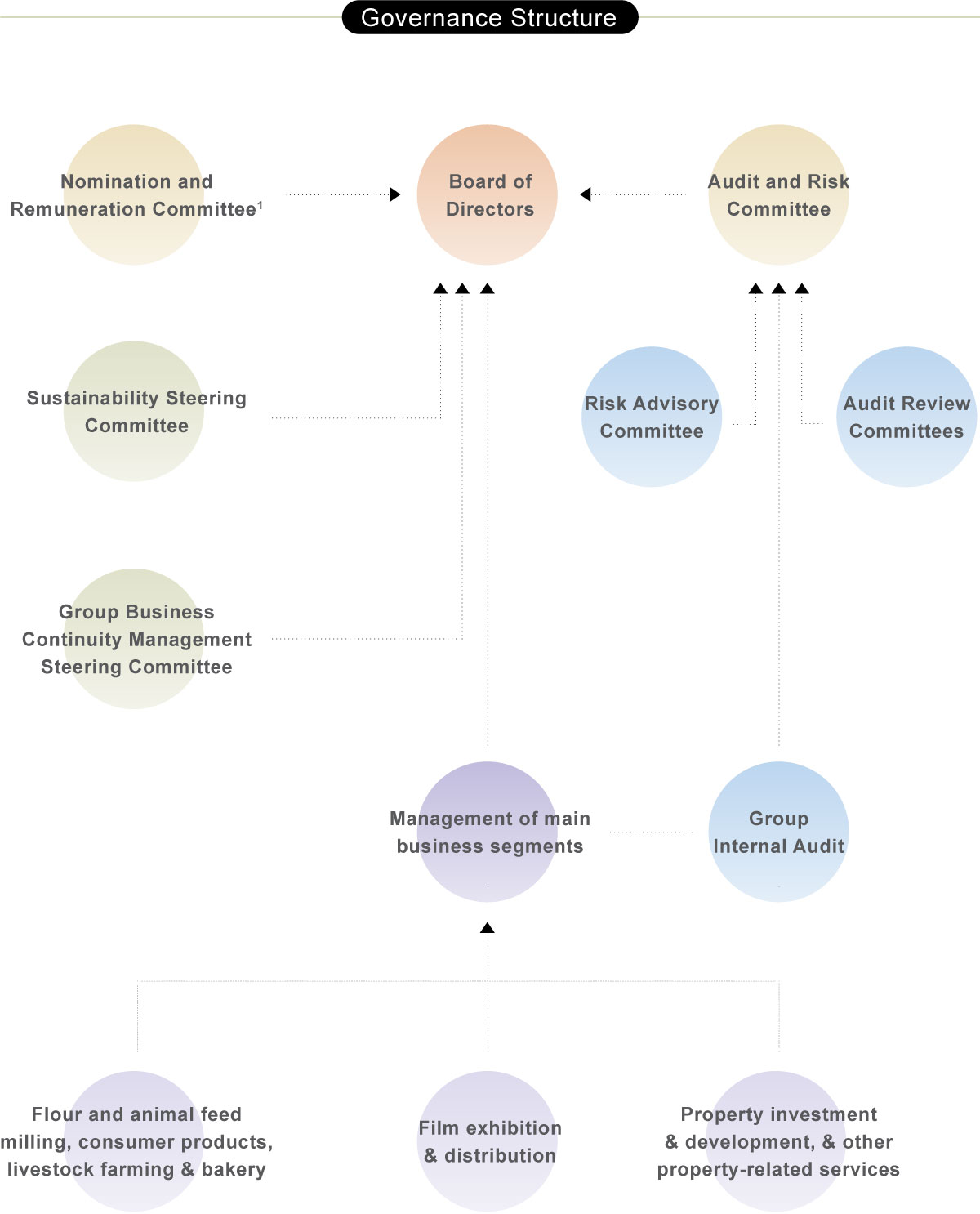
Notes:
- The previous separate Nomination and Remuneration Committees were replaced by a combined Nomination and Remuneration Committee during the year.
- During the year, the Integrity function was integrated into the Compliance scope of the Legal function. Accordingly, the previous Group Integrity Steering Committee was dissolved.
PRINCIPLE A – BOARD LEADERSHIP AND EFFECTIVENESS
Board Responsibilities
The board charter sets out matters reserved for the Board’s decision and outlines the Board’s roles and responsibilities. The schedule of matters for the Board’s decision includes amongst others, the overall Group strategy and direction; major policies, board and board committee appointments; approval of financial statements, corporate plans and budgets, material acquisitions and disposals of assets, and major investments. The Board charter includes the Board’s responsibilities on environmental, social and governance (“ESG”) matters which are pertinent and material to the Group and its stakeholders; as well as effective stakeholder communication and engagement.
The Board has oversight of the overall performance and control of the Group, setting and reviewing the strategic direction of the Group, and monitoring the implementation by management of that strategy. Specific responsibilities are delegated to several committees. These committees operate within Board-approved terms of reference, and have authority to examine issues and report to the Board with their findings and recommendations.
The roles of the Chairman and Group Managing Director are separate. The non-executive Chairman’s responsibilities include overseeing the governance process, provide board leadership on policy formation and decision-making, and ensure that appropriate steps are taken to provide effective communication with stakeholders. The Group Managing Director is responsible for overseeing the development and operations of the Group’s businesses, and implementing corporate strategies and objectives adopted and approved by the Board.
The Board sets the standards of conduct and personal behaviour to maintain a uniform set of values and ethics within the Group. An updated Group-wide code of ethics and conduct was approved by the Board in March 2024. A set of ‘Whistleblowing Policy and Procedures’ has been adopted by the respective business units throughout the Group, and is incorporated in the employee handbook. It is also available on the Company’s website: https://www.ppbgroup.com/index.php/governance-sustainability/ code-policies/whistleblowing-policy-and-procedures
Board Responsibilities
The board charter sets out matters reserved for the Board’s decision and outlines the Board’s roles and responsibilities. The schedule of matters for the Board’s decision includes amongst others, the overall Group strategy and direction; major policies, board and board committee appointments; approval of financial statements, corporate plans and budgets, material acquisitions and disposals of assets, and major investments. The Board charter includes the Board’s responsibilities on environmental, social and governance (“ESG”) matters which are pertinent and material to the Group and its stakeholders; as well as effective stakeholder communication and engagement.
The Board has oversight of the overall performance and control of the Group, setting and reviewing the strategic direction of the Group, and monitoring the implementation by management of that strategy. Specific responsibilities are delegated to several committees. These committees operate within Board-approved terms of reference, and have authority to examine issues and report to the Board with their findings and recommendations.
The roles of the Chairman and Group Managing Director are separate. The non-executive Chairman’s responsibilities include overseeing the governance process, provide board leadership on policy formation and decision-making, and ensure that appropriate steps are taken to provide effective communication with stakeholders. The Group Managing Director is responsible for overseeing the development and operations of the Group’s businesses, and implementing corporate strategies and objectives adopted and approved by the Board.
The Board sets the standards of conduct and personal behaviour to maintain a uniform set of values and ethics within the Group. An updated Group-wide code of ethics and conduct was approved by the Board in March 2024. A set of ‘Whistleblowing Policy and Procedures’ has been adopted by the respective business units throughout the Group, and is incorporated in the employee handbook. It is also available on the Company’s website: https://www.ppbgroup.com/index.php/governance-sustainability/ code-policies/whistleblowing-policy-and-procedures
Anti-bribery and corruption
The Board is responsible for the oversight of the Group’s Anti- Bribery and Corruption (“ABAC”) programme. It is committed to complying with anti-bribery and corruption laws in Malaysia and other countries in which the Group operates, and has approved the ‘Group ABAC Policy and Procedures’ (“ABAC P&Ps”) which applies to all directors and employees of PPB Group as well as business associates.
The ABAC P&Ps sets out PPB’s stance against bribery and corruption, managing conflicts of interest, policy on gifts, hospitality and entertainment, donations and sponsorship, handling facilitation payment requests and whistleblowing. It is communicated to all parties with whom the Group has business dealings, and is accessible to the public via the Group entities’ corporate websites. It may be viewed at the Company’s website: https://www.ppbgroup.com/index.php/governance-sustainability/ code-policies/anti-bribery-and-corruption-policy-and-procedures
The Company conducts an annual mandatory ABAC training session for its Directors and employees.
Pursuant to the dissolution of the Group Integrity Steering Committee, the Legal and Corporate Secretarial Department is tasked with overseeing the design, implementation, management, and continuous improvement of the ABAC programme and providing regular reports to the Board.
Governing Sustainability
The Board has oversight responsibility to deliver sustainable value to stakeholders through the principles, policies, objectives and strategies of the Group. In carrying out this responsibility, the Board is supported by the Sustainability Steering Committee (“SSC”) which was formed in 2017. The SSC is chaired by the Group Managing Director of PPB and comprises the Group Head of Sustainability, PPB’s department heads, as well as the chief executive and sustainability officers of the business units. The respective business units set, monitor and review ESG/sustainability targets, and report the performance/results achieved to the Board through the SSC.
Our updated Group Strategic Plan (2024-2028) includes sustainability goals, strategies and plans of the various business units. The Board has adopted a 5-year sustainability roadmap for the period from 2022 to 2026, which translates the Group’s vision and strategy into targets and initiatives to be achieved within the set timelines. The roadmap and plans are under the purview of the Board and the SSC.
Further details of the Group’s sustainability-related activities are set out in the 2024 Sustainability Report which is available on the websites of Bursa Malaysia (http://www.bursamalaysia.com) and PPB (https://www.ppbgroup.com).
Board and Committee meetings
The meetings of the Board and Board Committees held in FY2024 and attendance record are set out below:
| Meetings/Name of Director/Committee member | Number of meetings | |
|---|---|---|
| Held | Attended | |
| Board of Directors | ||
| Dato’ Capt Ahmad Sufian @ Qurnain bin Abdul Rashid | 9 | 9 |
| Mr Lim Soon Huat | 9 | 9 |
| Mr Soh Chin Teck | 9 | 9 |
| En Ahmad Riza bin Basir | 9 | 9 |
| Madam Tam Chiew Lin | 9 | 9 |
| Tengku Nurul Azian binti Tengku Shahriman | 9 | 9 |
| Ms Yip Jian Le | 9 | 9 |
| Ms Wee Lay Hua (Appointed on 1 Octocber 2024) |
2 | 2 |
| Datuk Ong Hung Hock (Retired on 17 May 2024) |
3 | 3 |
| Audit and Risk Commitee | ||
| Ms Yip Jian Lee (Chair) | 5 | 5 |
| Mr Soh Chin Teck | 5 | 5 |
| Madam Tam Chiew Lin | 5 | 5 |
| Tengku Nurul Azian binti Tengku Shahriman | 5 | 5 |
| Nomination Committee | ||
| En Ahmad Riza bin Basir (Chair) | 1 | 1 |
| Mr Soh Chin Teck | 2 | 2 |
| Datuk Ong Hung Hock (Retired on 17 May 2024) |
1 | 1 |
| Remuneration Commitee | ||
| Madam Tam Chiew Lin (Chair) | 1 | 1 |
| Tengku Nurul Azian binti Tengku Shahrima | 1 | 1 |
| Datuk Ong Hung Hock (Resigned on 17 May 2024) |
1 | 1 |
# These Committees were dissolved with effect from 1 October 2024 and a combined Nomination and Remuneration Committee (“NRC”) was formed. There was no NRC meeting held in FY2024.
In exercising their duties, directors have access to Company information and the support of the company secretary. The company secretary also updates directors on statutory, regulatory and related governance requirements relating to the discharge of their duties and responsibilities.
Board Composition
The Board comprises a majority of independent directors; of the eight Board members at end-2024, five are independent. The remainder of the Board comprises two non-independent non-executive directors (one of whom is the Chairman), and the Group Managing Director.
The independent directors are able to carry out their duties and express their views unfettered by familiarity, or business or other relationships. They provide skills, competencies as well as broader views to enhance the Board’s effectiveness.
The Board has agreed that annual shareholders’ approval be sought to extend the tenure of any director who has served for more than nine years as an independent director. Mr Soh Chin Teck and En Ahmad Riza bin Basir’s tenures as independent directors were further extended at the 55th Annual General Meeting (“AGM”) of the Company in 2024. The then Nomination Committee (“NC”) and the Board were satisfied that Mr Soh and En Riza are able to exercise independent judgment and act in the best interests of the Company, and recommended the continuation of their tenures as independent directors beyond nine years for shareholders’ approval at the 55th AGM.
The Board strives to achieve a balance and mix of skills, experience and perspectives amongst its directors, to collectively bring a range of experience, business, financial and technical expertise for effective oversight of the Group’s businesses, and fulfil the Board’s duties and responsibilities.
Annual re-election of directors
In accordance with the Company’s Constitution, one third of the directors retire by rotation at the AGM every year, and are subject to re-election by members. No director shall serve for more than three years from his/her last election.
The NC also reviews annually the training undertaken by Directors and recommends topics which are relevant or of interest to the Board to keep abreast with business and regulatory developments.
The Company organised several training sessions and field visits in 2024 which Directors attended, and these included the following:
Training sessions:
- The outlook for global and regional markets and key takeaways of Malaysia Budget 2025.
- Briefing on waste, the circular economy and impact of consumerism.
- Update on cyber-security awareness, and implementation of the Malaysian Cyber Security Act 2024.
- Annual integrity training pursuant to the Group’s antibribery and corruption framework.
Field visits:
- Visited the Raja Musa peat swamp forest reserve in northern Selangor including a briefing on carbon capture.
- Visited an oil palm estate in Selangor which included a briefing on human rights and forced labour.
During the year, Directors had also progressively attended Bursa Malaysia’s mandatory programme on sustainability
In addition, the following Directors attended other training sessions during the year, and the topics included:
| Name of Director | Title/Subject |
|---|---|
| Lim Soon Huat |
|
| Soh Chin Teck |
|
|
Tam Chiew Lin |
|
| Tengku Nurul Azian binti Tengku Shahriman |
|
| Yip Jian Lee |
|
| Wee Lay Hua |
|
The criteria for evaluation of candidates for appointment as directors (and senior management positions) include their qualification, occupation, professional and business experience, and is subject to the Company/ Group’s requirements and operating environment. Prospective candidates are not discriminated based on gender, age, cultural background etc.
The Group recognises the importance of identifying and developing potential leaders and managers to fill key positions (whether on the board or senior management) in the Company and Group, from both internal and external sources. This is an on-going process based on the Group’s immediate and longer term needs in terms of skills, expertise, knowledge and experience.
Board evaluation
Candidates for board appointments are reviewed by the NC and evaluated in accordance with the Directors’ Fit and Proper Policy of the Company before recommendation to the Board. The then NC was chaired by Encik Ahmad Riza bin Basir, an independent director. During the year, the NC reviewed and recommended the appointment of Ms Wee Lay Hua as an Independent Director. The NC assessed the proposed candidate’s character, experience, integrity, competence and time commitment to discharge her role effectively as a director.
The NC reviews annually the Board size and composition, diversity (including gender diversity), as well as the mix of Directors necessary for the successful direction of the Company and Group’s businesses. The NC also conducted a Board assessment, and assessment of the independent directors for 2024 which covered their experience and expertise/knowledge in the following areas:
- Business knowledge
- Accounting and financials
- Corporate governance, risk management and internal controls
- Legal and regulatory
- Human capital
- Information technology knowledge
- ESG/sustainability matters
The assessment included a review of the directorships of each board member, and their performance and contribution to the Board and respective Board Committees during the year. The NC also assessed the performance of the Audit and Risk Committee in FY2024. Based on the NC’s review and recommendation, the Board is satisfied with the number and composition of its members, and is of the view that the Board and the Board Committees have discharged their respective duties and responsibilities effectively.
Gender diversity
There is presently no formal gender diversity policy. The Board is of the opinion that it is important to recruit and retain the best available talent, taking into account the mix of skills, experience, knowledge and independence, and based on the Group’s needs and operating environment. Nonetheless, the Board continues to review board gender diversity, and it will continue to be one of the factors to be considered in evaluating prospective candidates when a board vacancy arises.
Remuneration
The Board reviews the overall remuneration of executive and non-executive directors at intervals to attract and retain directors with the relevant experience and expertise.
The Group Managing Director’s remuneration is determined after taking into account his duties and responsibilities as Group Managing Director of PPB, his roles in various capacities in the main business units, his performance rating and the Group’s performance for the year. For non-executive directors, the remuneration reflects their roles and responsibilities, and the recommendation thereof is a matter for the Board as a whole subject to shareholders’ approval.
The individual directors’ remuneration paid/payable for FY2024 on a Group and Company basis are set out below:
| GROUP | |||||||
|---|---|---|---|---|---|---|---|
| Figures in RM’000 | Fees | Salary | Bonus | Allowances | Benefits-in-kind | Other emoluments | Total |
| Dato’ (Dr) Capt Ahmad Sufian @ Qurnain bin Abdul Rashid | 550 | – | – | 12 | 37 | 599 | |
| Lim Soon Huat | 30 | 1,380 | 2,500 | – | 25 | 622 | 4,557 |
| Datuk Ong Hung Hock | 40 | – | – | 7 | – | – | 47 |
| Soh Chin Teck | 134 | – | – | 30 | – | – | 164 |
| Ahmad Riza bin Basir | 100 | – | – | 14 | – | – | 114 |
| Tam Chiew Lin | 124 | – | – | 19 | – | – | 143 |
| Tengku Nurul Azian binti Tengku Shahriman | 123 | – | – | 17 | – | – | 140 |
| Yip Jian Lee | 119 | – | – | 19 | – | – | 138 |
| Wee Lay Hua | 23 | – | – | 3 | – | – | 29 |
| COMPANY | |||||||
|---|---|---|---|---|---|---|---|
| Figures in RM’000 | Fees | Salary | Bonus | Allowances | Benefits-in-kind | Other emoluments | Total |
| Group Managing Director | |||||||
| Lim Soon Huat | – | 1,380 | 2,500 | – | 25 | 622 | 4,527 |
| Non-executive Directors | |||||||
| Dato’ (Dr) Capt Ahmad Sufian @ Qurnain bin Abdul Rashid | 550 | – | – | 12 | 37 | – | 599 |
| Datuk Ong Hung Hock | 40 | – | – | 7 | – | – | 47 |
| Soh Chin Teck | 134 | – | – | 26 | – | – | 140 |
| Ahmad Riza bin Basir | 100 | – | – | 14 | – | – | 114 |
| Tam Chiew Lin | 124 | – | – | 19 | – | – | 143 |
| Tengku Nurul Azian binti Tengku Shahriman | 123 | – | – | 17 | – | – | 140 |
| Yip Jian Lee | 119 | – | – | 19 | – | – | 138 |
| Wee Lay Hua | 23 | – | – | 3 | – | – | 26 |
The remuneration of the top five senior management of the PPB Group (excluding those who are also Directors of PPB) paid/payable for FY2024 on an aggregated basis in RM50,000 bands is as follows:
| Remuneration bands | Number of senior management staff |
|---|---|
| RM1,200,001 – RM1,250,000 | 1 |
| RM1,450,001 – RM1,500,000 | 1 |
| RM1,600,001 – RM1,650,000 | 1 |
| RM2,200,001 – RM2,250,000 | 1 |
| RM2,950,001 – RM3,000,000 | 1 |
The Group senior management remuneration is commensurate with their duties and responsibilities, their work performance, and the performance of the respective business entity. The Board is of the opinion that the disclosure of the senior management’s names and remuneration components would not be in the best interest of the Group due to confidentiality, business and personal security concerns. The above disclosure is deemed sufficient to enable stakeholders to assess senior management remuneration vis-a-vis the Group’s performance.
PRINCIPLE B – EFFECTIVE AUDIT AND RISK MANAGEMENT
Audit Committee
The Audit and Risk Committee (“A&RC”) presently comprises a majority of independent directors; the A&RC Chair is also separate from the Chairman of the Board.
The principal functions of the A&RC include the following:
- Ensure that the financial statements comply with applicable financial reporting standards, and assess the suitability and independence of external auditors.
- Assess the adequacy and effectiveness of the Group’s enterprise-wide risk management and internal control framework.
The members of the A&RC possess a mix of skills, knowledge and experience to enable them to discharge their duties and responsibilities pursuant to the A&RC’s terms of reference, which are available on the Company’s website. The annual self and peer evaluation of the A&RC was carried out and reviewed by the NC. The Audit and Risk Committee Report on pages 58 to 60 of this annual report provides more details on the A&RC’s functions during the year.
Risk management and internal control framework
Responsibility for ensuring a sound internal control system and reviewing the effectiveness of the system lies with the Board. The Group’s system of risk management and internal control is designed to manage, rather than eliminate, the risk of failure to achieve the Company’s corporate objectives and safeguard the Group’s assets. It therefore provides reasonable but not absolute assurance against material misstatement, fraud or loss.
A risk management and internal control framework has been established which covers the Group’s risk assessment process and internal controls, with oversight and reporting on the effectiveness of this function. There were no significant risk management and internal control failings or weaknesses which resulted in material losses or contingencies during the financial year.
The Statement on Risk Management and Internal Control set out on pages 56 to 57 of this annual report provides a more detailed description of the state of risk management and internal controls.
PRINCIPLE C – INTEGRITY IN CORPORATE REPORTING AND MEANINGFUL RELATIONSHIP WITH STAKEHOLDERS
Communication with stakeholders
PPB’s Corporate Disclosure Policy (“CDP”) sets out the disclosure policies and procedures, and provides a framework to communicate effectively with stakeholders and the public generally. The policy may be viewed at the Company’s website: https://www.ppbgroup.com/index.php/governance-sustainability/code-policies/corporate-disclosure-policy
The Company seeks to provide stakeholders with timely, accurate, clear and equal access to material information on the Company’s performance and operations. The principal sources of information disseminated by the Company during the year include the annual report, quarterly investor updates, news releases and company website.
PPB’s investor relations programme is directed at both individual and institutional investors, with the objective to maintain ongoing awareness of the Company’s performance amongst shareholders, media and the investing community. This includes twice-yearly analyst briefings after the release of the half-year and final results together with media conferences. The Company makes every attempt to meet requests for meetings or information from the investing community.
PPB’s 2024 Sustainability Report is guided by the following:
- Bursa Malaysia Securities Berhad Main Market Listing Requirements in relation to Sustainability Reporting Requirements.
- National Sustainability Reporting Framework.
- Global Reporting Initiative (“GRI”) Standards 2021, including the sector standard GRI 13: Agriculture, Aquaculture and Fishing Sectors 2022.
The Company continues to support the United Nations Sustainable Development Goals (“SDGs”) and has aligned its sustainability priorities with the relevant SDGs.
Conduct of general meetings
The 55th Annual General Meeting (“AGM”) held on 17 May 2024 was convened as a fully physical meeting. Notwithstanding this, all shareholders were able to submit questions and their proxy votes prior to the meeting.
The notice of the 55th AGM was sent to members 28 days before the meeting together with the annual report. The AGM notice sets out the resolutions to be tabled and includes explanatory notes and other relevant information on the matters to be discussed and decided at the AGM. Shareholders were able to exercise their votes either in person, or appoint a representative or proxy to attend and vote on their behalf. Voting was by poll, conducted electronically and verified by an independent scrutineer.
It is the Company’s practice that all Board members, including the respective chairs of the various committees attend AGMs and are available to deal with any questions on matters under their purview. At the meetings, shareholders can express their views or raise questions relating to the Group’s financial performance and business operations. Questions from shareholders relating to the Company’s financial and business operations were dealt with by the Chairman, the Group Managing Director and Group Chief Financial Officer of the Company.
The minutes of the 55th AGM were also uploaded to PPB’s website and can be accessed via the link below: https://www.ppbgroup.com//wp-content/uploads/2025/11/Minutes-of-55th-AGM.pdf
Focus Areas on Corporate Governance
The Group Strategic Plan adopted in 2024 covers the various business units, and takes into consideration inter alia, new trends and developments, and enhanced ESG considerations. The continuing focus in 2025 would be to further enhance directors’ and senior management’s knowledge and application of ESG considerations in the Group’s business operations and activities, in particular the monitoring, reporting and disclosure requirements to regulators and other stakeholders.
This statement was approved by the Board on 26 March 2025.
Note :
The Corporate Governance Report (“CGR”) for FYE 2024 can be read here :-